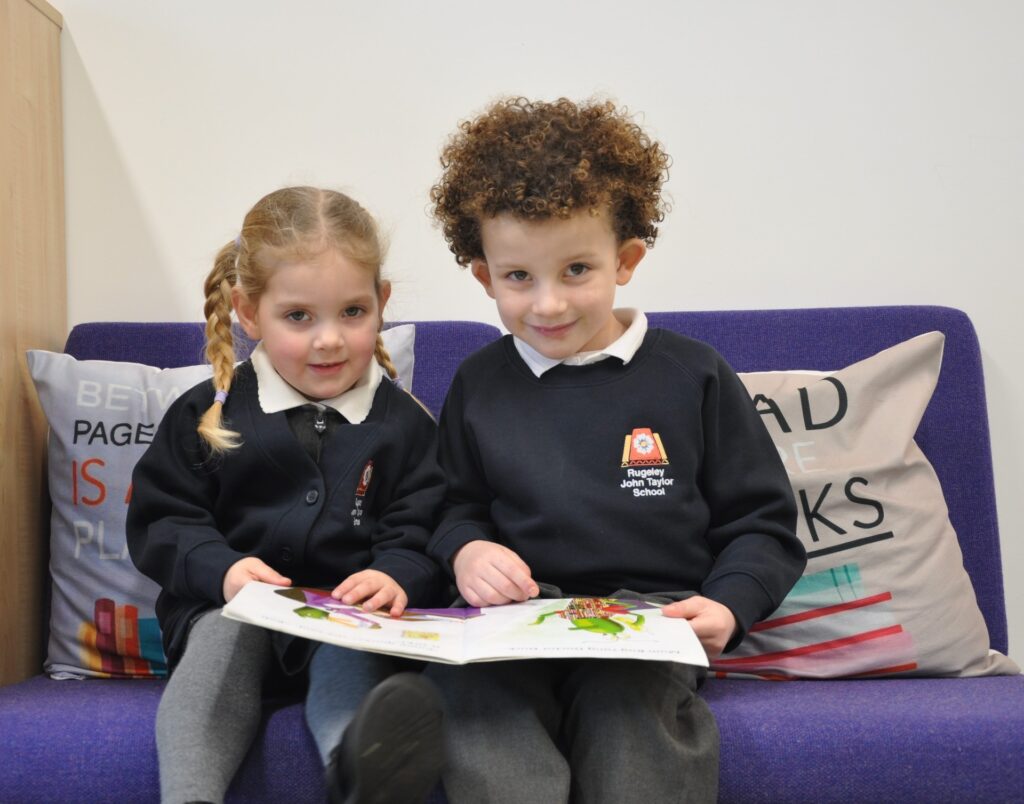
In our Early Years Foundation Stage, children learn through play, talk, exploration and carefully planned teaching. Learning is organised into seven areas of learning and development, which work together to build confident, happy learners.
Our mission and values
Our mission is to empower every learner through knowledge and ambition, fostering a culture of respect, resilience and readiness. We provide a high-quality education that inspires curiosity, nurtures personal growth, and prepares learners to live lives full of choice and opportunity in a diverse and evolving world.
Our core values are simple and child-friendly: We are respectful. We are resilient. We are ready. We are Rugeley John Taylor.
The 4 EYFS overarching principles – our Rugeley John Taylor approach
The EYFS is built on 4 overarching principles.
- A Unique Child – Every child is an individual with their own strengths, interests and needs. At Rugeley John Taylor, we get to know your child well, celebrate what makes them unique, and provide the right support and challenge so they can thrive.
- Positive Relationships – Children learn best when they feel safe and connected. At Rugeley John Taylor, we prioritise warm, consistent relationships with adults and peers, and we work closely with families, so school and home feel joined up and supportive.
- Enabling Environments – Children learn through what they do and what they experience. At Rugeley John Taylor, we create calm, organised and inspiring indoor and outdoor environments where children can explore, choose resources independently, and revisit learning often.
- Learning and Development – Children develop rapidly in the early years and learn in different ways. At Rugeley John Taylor, we plan a rich, play-based curriculum across the seven areas of learning, with purposeful teaching and plenty of time for practice, repetition and depth.
Our EYFS vision
- A happy, nurturing start where children feel emotionally secure and develop strong relationships.
- A rich, play-based curriculum that builds knowledge, language and key skills step-by-step.
- High expectations for all children, with support, challenge and inclusion so everyone can thrive.
- Daily opportunities for communication, creativity, outdoor learning and practical exploration.
- A strong partnership with families, because children learn best when home and school work together.
How children learn best (Characteristics of Effective Learning)
We plan learning that helps children become strong learners through three keyways of learning:
- Playing and exploring – children investigate and experience things, and “have a go”.
- Active learning – children concentrate and keep on trying if they encounter difficulties and enjoy achievements.
- Creating and thinking critically – children have and develop their own ideas, make links between ideas, and develop strategies for doing things.
Adults support these behaviours by watching and listening closely, modelling language, asking thoughtful questions, and giving children time and space to explore deeply.
What we teach
Children learn through seven areas of learning and development. The Prime areas build strong foundations, and the Specific areas broaden and apply learning. These areas are interconnected and develop together.
Prime Areas
Personal, Social and Emotional Development (PSED)
Children learn to understand themselves and others, manage emotions, build relationships, and develop confidence and independence.
- Routines, turn-taking and friendships
- Managing feelings and self-regulation
- Independence, resilience and a positive mindset
Communication and Language (CL)
Children develop listening, attention and understanding, and become confident speakers who can share ideas and ask questions.
- Stories, talk, songs and vocabulary
- Talk partners and group discussions
- Questioning, explaining and retelling
Physical Development (PD)
Children build strong bodies and strong hands for movement, healthy habits, independence and early writing readiness.
- Gross motor: balance, coordination, outdoor games
- Fine motor: cutting, threading, dough and tool use
- Self-care and healthy routines
Specific Areas
Literacy
Children learn to love books, build vocabulary and understanding, and begin to read and write through phonics and meaningful experiences.
- Daily Phonics in Reception
- Sharing high-quality stories and non-fiction
- Purposeful mark-making and early writing in play
Mathematics
Children develop secure number sense and early mathematical thinking through counting, subitising, comparison, pattern, shape and measures.
- Counting and number games
- Subitising and composition (numbers within numbers)
- Practical pattern, shape and measuring experiences
Understanding the World (UTW)
Children explore people, places, time and the natural world—developing curiosity, asking questions and making sense of what they observe.
- Seasonal learning and outdoor exploration
- Simple investigations (predict–test–talk)
- Learning about community, culture, and “then and now”
Expressive Arts and Design (EAD)
Children express ideas and feelings through art, music, dance, drama and role play—developing creativity, imagination and confidence.
- Creating with a wide range of materials
- Music, rhythm and movement
- Storytelling and role play
What learning looks like day to day
- A balance of child-initiated play and adult-led teaching (whole class, small group and 1:1).
- Daily routines that build independence (self-registration, snack routines, tidying, transitions).
- Language-rich interactions all day: adults’ model new words and encourage children to explain and share ideas.
- Continuous provision indoors and outdoors, with carefully chosen resources children can self-select.
- Enhanced provision: planned invitations linked to what children are learning and what we notice they need next.
- Regular reflection: children share learning, revisit creations, and celebrate effort and improvement.
Nursery: what your child will experience
In Nursery we focus on settling, security and foundations. Children build confidence, routines, language and early skills through purposeful play and supportive adult interaction.
- Strong relationships and routines: helping children feel safe and confident.
- Talk and vocabulary: songs, stories, small-world play and rich conversation.
- Early maths in play: counting collections, sorting, comparing, patterns and shape.
- Fine motor development: dough, cutting, threading, mark-making and tool practice.
- Outdoor learning every day: movement, nature exploration and sensory play.
- Creativity and imagination: open-ended art, music and role play, including storytelling opportunities.
Reception: what your child will experience
In Reception we deepen skills and knowledge and help children become ready for Year 1. Teaching remains play-based, with more structured learning in phonics, early reading and writing, and maths while protecting time for creativity, exploration and outdoor learning.
- Daily phonics and early reading: learning sounds, blending and building fluency.
- Early writing: sentence ideas, handwriting readiness, and purposeful writing in play.
- Mastering number sense: subitising, counting principles, comparison and composition within 10.
- Wider curriculum: learning about time, place, seasons, communities and “then and now”.
- Expressive arts: creating with materials, music, movement and role play; sharing and valuing others’ work.
- Growing independence: managing belongings, following routines, and taking responsibility.
Storytelling and imagination
We value children’s stories. Storytelling supports language, confidence and creativity. Through approaches such as Helicopter Stories, children can dictate their own stories, see them written down, and act them out with friends. This helps every child develop a voice and build a love of narrative and performance.
Assessment and how we keep you informed
Assessment in EYFS is observation-based and low-stakes. We watch what children can do in everyday routines, play and adult-led learning, and use this to plan next steps.
- Statutory Reception Baseline Assessment (RBA). The RBA is a short, interactive and practical assessment of your child’s early literacy, communication, language and mathematics skills when they begin school.
- Baseline (first few weeks): to understand starting points and settle children quickly into learning.
- Ongoing observations: notes, photographs and children’s talk help us see progress over time.
- Regular updates to parents: informal conversations, key messages, and shared learning.
- Reception: at the end of the year, children’s attainment is assessed against the Early Learning Goals (EYFSP) and shared with parents and Year 1 teachers.
Inclusion and support
Every child is unique. We provide inclusive practice for all children, including those with SEND and children learning English as an additional language. We adapt resources, provide visual supports, pre-teach key vocabulary, and work closely with families and specialists to ensure children succeed.
How you can help at home
- Talk together every day: ask open questions (“What did you notice?” “How did that make you feel?”).
- Read daily: share stories, talk about pictures, and revisit favourite books.
- Play with numbers: count in real life (stairs, plates, socks), play board games, spot patterns.
- Build independence: dressing, toileting routines, turn-taking games, tidying up together.
- Encourage creativity: draw, paint, make models from recycling, sing songs, dance and act out stories.
Transition to Reception and Year 1
We support smooth transitions through familiar routines, visits, shared activities and careful handover conversations. Children are helped to become confident learners who can listen, join in, communicate, and manage their needs with increasing independence.
Contact and partnership
If you have any questions about our EYFS curriculum, please contact the school office or speak to your child’s class team. We value working together with families and welcome your insights about your child’s interests, strengths and needs.